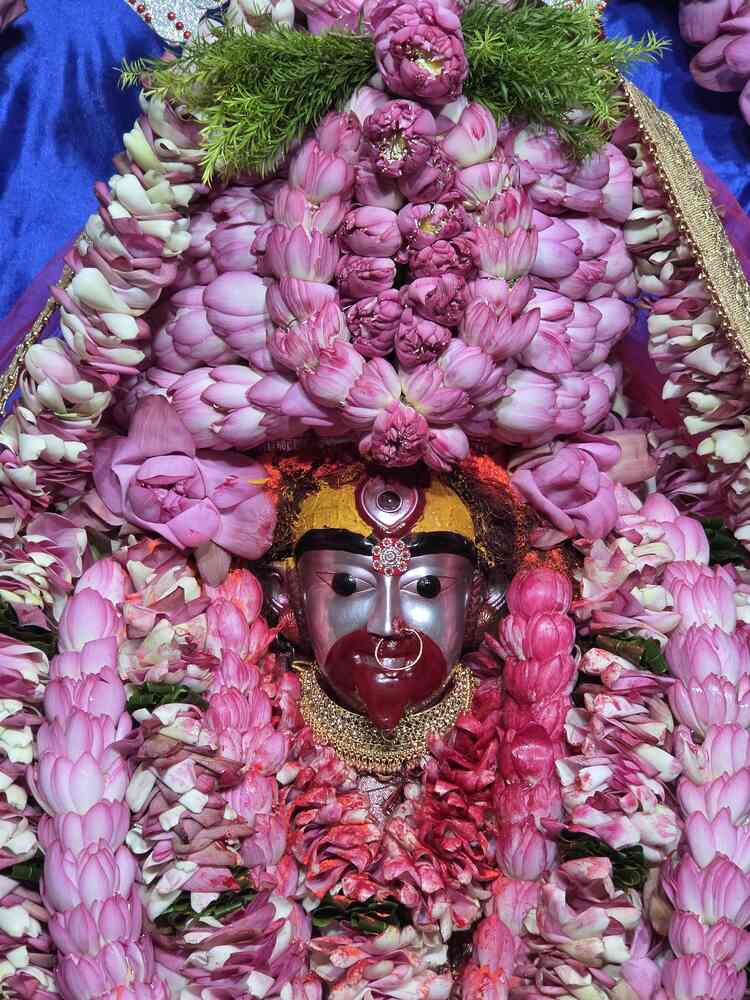
Beside the temple of Maa Tara lies the Maha Smashan, the cremation ground that forms an essential part of Tarapith’s sacred landscape. For many devotees and spiritual practitioners, the temple and the cremation ground are not separate places. Together they express the many-sided nature of the Divine Mother: nurturing and protective, yet also beyond fear, change and death.
A PLACE OF TANTRIC PRACTICE
Tarapith has long been associated with Shakta-Tantric worship. Local tradition remembers the cremation ground as a place where the sage Vasistha and later sadhakas undertook spiritual disciplines. The panchamundi asana and the story of the white semal tree are part of the sacred lore connected with this landscape. These are traditional accounts and should be understood as religious memory rather than independently dated archaeological events.
MODERN FIELD RESEARCH
The Maha Smashan is also discussed in contemporary academic research. A 2025 study in the journal Religions, based on ethnographic fieldwork among Tantric ascetics at Tarapith between 2016 and 2018, describes the cremation ground as an important setting for Tantric practice. The study records how practitioners interpret rituals in relation to confronting fear, seeking a vision of the divine and transforming their understanding of death. It cautions against reducing these practices to sensational stories about magic.
WHY THE CREMATION GROUND MATTERS
In Shakta traditions, the cremation ground can represent impermanence and the limits of ordinary identity. The presence of Maa Tara in this setting is understood by devotees as a sign that the Mother is present even where people feel most vulnerable. The site’s spiritual meaning is therefore not simply about death; it is also about courage, surrender and the possibility of inner transformation.
The Maha Smashan has attracted ascetics, pilgrims and visitors for generations. Its reputation is closely linked with the life and devotion of Bamakhepa, whose name remains inseparable from Tarapith. Visitors should approach the area respectfully and follow local temple guidance, remembering that it is an active sacred and cremation space, not a tourist performance.
SOURCES & FURTHER READING
1. “Anthropology of the Profane,” Religions, 2025, based on fieldwork at Tarapith: https://www.mdpi.com/2077-1444/16/2/227
2. Oxford Journal of Hindu Studies, “From Bauddha Desa to Sakta Pitha: Re/Locating the Hindu Goddess Tara”: https://academic.oup.com/jhs/article/17/2/175/7635536
3. “The Maha Shmashan,” Maa Tara Pith Temple: https://tarapith.org/the-maha-shmashan/
4. West Bengal Tourism Department, “Tarapith”: https://wbtourism.gov.in/topDestination/details1?id=63d8d4236327ed072c056a2c&template_id=1
Tarapith Maha Smashan: The Sacred Ground of Sadhana
Learn about the Maha Smashan at Tarapith through local tradition and contemporary academic field research.