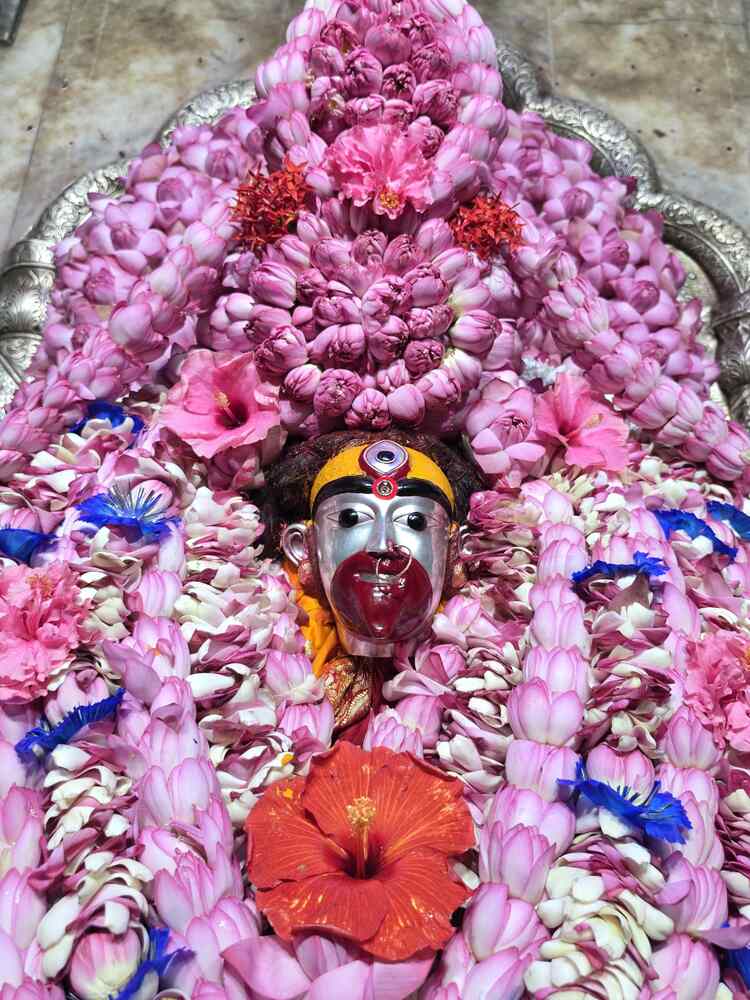
The image of Maa Tara nursing Lord Shiva is among the most distinctive features of Tarapith’s sacred tradition. It presents the Divine Mother in a deeply intimate form: fierce in her cosmic power, yet tender and protective as a mother caring for her child.
THE STORY OF HALAHALA
Hindu Puranic traditions tell of the churning of the Ocean of Milk, known as Samudra Manthana. Devas and asuras churn the cosmic ocean in search of amrita, the nectar of immortality. Before the nectar appears, a deadly poison called Halahala emerges and threatens the worlds. Lord Shiva accepts the poison to protect creation. The poison turns his throat blue, giving him the name Neelkantha.
At Tarapith, a local sacred telling gives this episode a maternal conclusion. Maa Tara takes Shiva onto her lap and nurses him, soothing the burning caused by the poison. The stone image hidden within the sanctum is traditionally understood as Tara in this motherly act. The visible decorated image and the inner stone form together shape the special iconography revered by devotees.
A SYMBOL OF THE MOTHER’S COMPASSION
The story is more than a description of an image. It teaches that divine power is not only the force that destroys evil; it is also the compassion that heals and protects. Shiva, who bears the danger for the universe, receives the care of the Mother. Devotees see in Tara the one who carries beings through fear, pain and uncertainty.
The West Bengal Tourism Department describes the Tarapith image as showing Tara with Shiva on her lap and notes that the golden covering of the image is removed at night. Academic writing on the goddess Tara also discusses the maternal icon and its relationship to the wider story of Shiva drinking the cosmic poison. These sources help distinguish the local iconographic tradition from the many variations of the Samudra Manthana story found across Hindu texts.
THE IMAGE AT TARAPITH
The visible form of Maa Tara is richly adorned and is approached with reverence by devotees. The hidden stone form is central to the temple’s sacred memory. The two forms are not treated by worshippers as competing images; they are understood as different ways the Mother’s presence is made accessible in the shrine.
SOURCES & FURTHER READING
1. West Bengal Tourism Department, “Tarapith”: https://wbtourism.gov.in/topDestination/details1?id=63d8d4236327ed072c056a2c&template_id=1
2. Oxford Journal of Hindu Studies, “From Bauddha Desa to Sakta Pitha: Re/Locating the Hindu Goddess Tara”: https://academic.oup.com/jhs/article/17/2/175/7635536
3. Srimad Bhagavatam, Canto 8, Chapter 7, “Lord Shiva Saves the Universe by Drinking Poison”: https://vedabase.io/en/library/sb/8/7/
Why Maa Tara Is Shown Nursing Lord Shiva
Understand the maternal Tara image at Tarapith and the traditional story of Shiva and the Halahala poison.