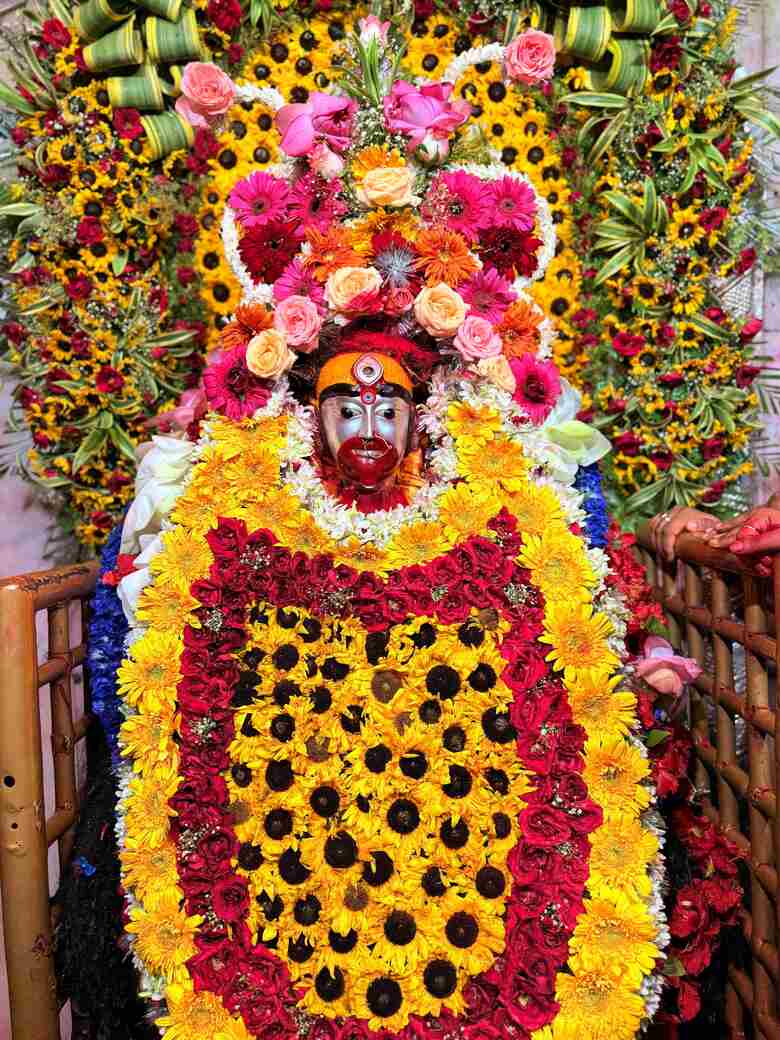
The present Tara temple at Tarapith is the result of a long history of worship, patronage and rebuilding. The sacred site is older in local memory than the building that visitors see today, and it is important not to confuse the age of the tradition with the construction date of the present structure.
Early Temple And Patronage
Historical accounts of the shrine refer to earlier temple structures and to the support of local rulers and patrons. A study preserved in the University of Oxford Research Archive records that the temple was endowed with land in the mid-eighteenth century by Rani Bhavani of Natore and her adopted son Ramakrishna. The same study notes that the existing structure replaced an earlier temple that had been damaged by lightning.
The Present Temple: 1818
The Oxford research account states that the temple as it now stands was constructed in 1818 by Jagannath Ray, a wealthy businessman from nearby Mollarpur. It notes that a plaque installed in 1951 by Ray’s successors records this construction. A scholarly chapter on the Shakti Peethas of West Bengal likewise identifies Jagannath Ray as the builder of the present temple, completed in 1818, and connects the work with the rebuilding of the earlier shrine.
There are also public descriptions that call Tarapith a thirteenth-century temple. The West Bengal Tourism Department uses this broad description. Such references may reflect the older sacred site or earlier temple tradition, whereas the Oxford account and the scholarly chapter discuss the present building and its documented construction. These dates should not be collapsed into a single claim: the temple’s religious history and the date of the standing structure are different questions.
A Bengal Temple Form
The shrine is associated with Bengal’s regional temple architecture. The tourism department describes a curved-roof form and a red-brick base. The temple compound grew over time through donations, additional shrines and facilities. The Oxford study notes that inscriptions record numerous donations and improvements from the twentieth century onwards.
A Living Heritage
Tarapith is not only an architectural monument. Its history is inseparable from the worship of Maa Tara, the temple’s ritual calendar, the nearby Chandrachura Shiva shrine and the spiritual reputation of the Maha Smashan. The temple remains a living place of worship, maintained through the devotion and contributions of its community.
▤ Sources & Further Reading
- University of Oxford Research Archive, “Hindu Pilgrimage, with Particular Reference to West Bengal, India,” section “The Temple”: https://ora.ox.ac.uk/objects/uuid:690a2734-2493-4e1d-b551-d391bec4b0a5
- De Gruyter, “6 Shakti-Pithas of West Bengal: Seven Case Studies”: https://www.degruyterbrill.com/document/doi/10.1515/9783111243979-006/pdf
- West Bengal Tourism Department, “Tarapith”: https://wbtourism.gov.in/topDestination/details1?id=63d8d4236327ed072c056a2c&template_id=1
- District Digital Cultural Repository, Birbhum, “Tarapith Temple”: https://www.wbicad.in/pdf/BIRBHUM.pdf
 03 Nov 2026Sadhak Bamakhepa: The Saint Whose Devotion Made Tarapith Famous
 03 Nov 2026Tarapith Maha Smashan: The Sacred Ground of Sadhana
 03 Nov 2026Why Maa Tara Is Shown Nursing Lord Shiva
 03 Nov 2026The Legend of Sage Vasistha and Maa Tara
 03 Nov 2026Tarapith: The Sacred Land of Maa Tara